Smart Newborn Essentials
Technology That Supports the Baby Year
Seven smart baby tools — chosen for time saved, friction removed, and the specific hours when they matter most:
— SNOO Smart Sleeper
— Nanit Pro Baby Monitor
— Baby Brezza Formula Pro Advanced
— Elvie Breast Pump
— Cybex e-Priam stroller system
— Hatch Rest Sound Machine
— Owlet Dream Sock

The Quiet Systems
Nobody tells you about the decisions. You expect the tiredness — everyone warns you about the tiredness — but the mental load of the first months arrives more quietly. Feeding schedules you hold in your head all day, nap windows that close in thirty minutes, appointments you booked at eight weeks and need to confirm, the question of whether the room is too warm or just warm enough. It runs continuously. It doesn't pause between the moments that matter.
Good baby technology doesn't replace you. It takes on the parts of the job that don't need you — the mechanical steps, the repetitive sequences, the monitoring that would otherwise sit in the back of your mind all night. The seven tools here were chosen for one quality: they make a specific moment in the baby year reliably easier, without creating a new problem in its place.
The most valuable tools of the baby year are often the quietest ones — the systems running in the background while you focus on the person who needs you most, far removed from the simplified cultural images of motherhood that still circulate in film and literature.
As explored in our essay on The Modern Mother, the environment you build around yourself in the first year is never neutral. It includes the objects you use every day, the systems that remove friction, and the quieter, more deliberate wardrobe choices that accompany early motherhood.
It either absorbs the weight of the day or adds to it. These seven tools are an attempt at the former.
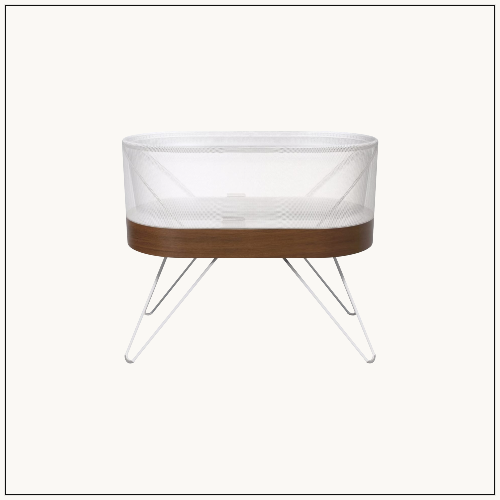
1. The Bassinet
SNOO Smart Sleeper
WHAT IT ACTUALLY DOES
→ Detects crying and responds automatically — rocking starts, white noise rises — before you need to get up
→ Calibrates the intensity of its response to the level of the baby's distress
→ The secure swaddle attachment keeps the baby safely on their back all night, every night
→ Tracks each night's sleep and shows you the data in the morning — total hours, wake events, patterns over time
→ Has a weaning mode to help transition out of the bassinet gradually when the time comes
TIME SAVED
Around 1–2 hours of additional sleep per night in the early weeks. Parents typically go from 4–5 wake-ups requiring intervention to 1–2. That's not just extra sleep — it's the difference between surviving the week and getting through it in one piece.
The first weeks do something strange to time. Nights stop being nights and become a series of small decisions — go in now, or wait another minute. The SNOO handles a good portion of those decisions itself. When the baby stirs, it responds first. Often that's enough. If it isn't, you'll hear about it.
The cost is significant, and the window of use is defined — about six months, until the baby outgrows the swaddle. Whether that investment makes sense depends entirely on how much you value sleep in that specific window. By week three, most parents who use it stop doing the calculation.
Sleep is the most fragile part of the baby year. The SNOO doesn't fix it — it catches enough of the breaks to make the whole thing hold.
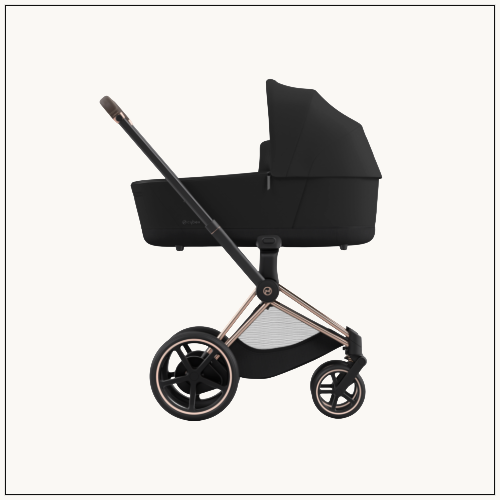
2. The Stroller
Cybex e-Priam
WHAT IT ACTUALLY DOES
→ Electric motor assistance on hills and uneven ground — cobblestones, inclines, gravel paths — so you're not bracing into every push
→ One-hand electric fold in under 3 seconds: one motion, done, no choreography
→ Automatic rocking mode via the Cybex app — the frame rocks itself while stationary, so a nap continues while you sit down
→ The Cloud T i-Size car seat clicks directly onto the frame — no adapters, no waking a sleeping baby to transfer
→ The Luxury Carry Cot also clicks on for the newborn months, same chassis throughout
→ All-terrain suspension that absorbs impact without you feeling it
→ Matte finishes and clean lines — it doesn't look like nursery furniture, which matters when you're pushing it through the world every day for three years
TIME SAVED
The fold alone — under 3 seconds versus 15–20 for a manual frame, twice or more daily — adds up over three years. The rocking function returns 20–40 minutes per nap. Motor assistance removes the physical accumulation of a sleep-deprived body trying to push uphill.
Movement changes with a baby. Hills you never noticed before feel steep. The distance from the car to the café is suddenly meaningful. Running on four hours of sleep and pushing a weighted frame into a headwind is a specific kind of tired. The e-Priam's motor doesn't do the walking for you — it just removes the resistance, so the walk is the walk again.
The fold is the thing people talk about least and notice most. In the rain, one shoulder loaded, child who is done — one hand, one press, it's folded. The world stays open.
Even walking becomes part of the infrastructure of the baby year. The e-Priam is built for the mother who hasn't stopped moving and doesn't intend to.
For the full picture on the system — the travel integration, the design, and how the stroller shapes movement through the baby year — see our dedicated Cybex e-Priam journal.
The e-Priam is featured in our The Modern Mother Edit.
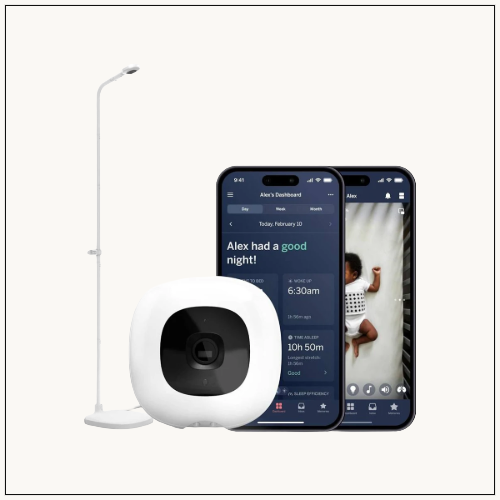
3. The Monitor
Nanit Pro Baby Monitor
WHAT IT ACTUALLY DOES
→ Overhead HD camera positioned directly above the cot — full, unobstructed view regardless of where the baby has moved
→ Breathing monitoring via a small wearable band on the baby's clothes — alerts if anything moves outside the normal range
→ Real-time sleep tracking that logs wake events, cycle length, and total sleep
→ Environmental sensors for temperature and humidity in the room
→ Morning sleep score — a number that summarises the night, so you're not reconstructing it from memory
→ Background audio so you can listen without watching
→ Split-screen if you have multiple children in different rooms
TIME SAVED
Removes roughly 45 minutes to 1 hour of physical room checks per night. Parents who'd otherwise get up every 20–30 minutes to confirm the baby is breathing can check from the phone screen and go back to sleep.
There's an anxiety that comes with a new baby that isn't quite a fear — it's more like a background hum that runs even while you're asleep, which is part of why the sleep is never fully restorative in the early months. Every unusual silence sets it off. The Nanit replaces the hum with information. You open the app and you can see them breathing. That's it. That's the whole thing.
The overhead angle is the detail that makes the difference. No blind spots. No repositioning. The baby moves to one side and you can still see their face. Once you've used it, a camera mounted on the side of the room feels like guessing.
Parents don't just watch their babies — they watch for patterns. The Nanit provides that layer, and patterns change what kind of worry you carry.
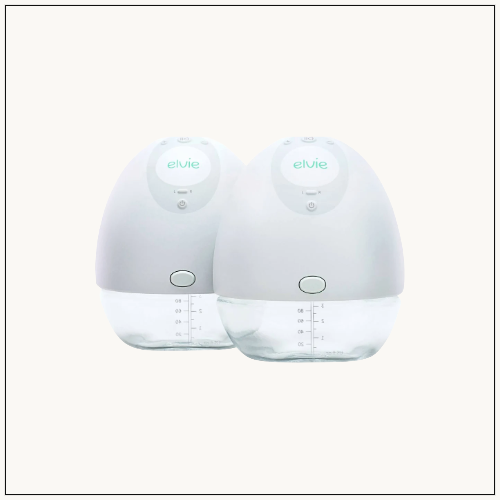
4. The Pump
Elvie Breast Pump
WHAT IT ACTUALLY DOES
→ Fits entirely inside a standard nursing bra — no external tubes, no motor unit on a table, no cord
→ Silent enough to use in a meeting without anyone knowing
→ App tracks milk volume from each breast in real time so you always know output without guessing
→ Cordless, so usable anywhere — desk, car, sofa, commute
→ Adjustable suction and rhythm modes, controllable from the phone
→ Dishwasher-safe parts — fewer steps to clean
TIME SAVED
Traditional pumping: 20–30 stationary minutes, twice or more a day. With the Elvie, those sessions happen inside other activities — the commute, a call, a meeting. The same principle applies to quick beauty routines that fit inside the morning rather than delaying it. You're not losing the time, you're just not losing anything else alongside it.
The breast pump used to require a room. Sit down, attach the machine, wait — tethered to a wall, unable to do much else. For a working mother, that meant scheduling pumping as time extracted from the day. The Elvie removes the extraction. A call keeps going. A meeting proceeds. You're present for both.
It runs quietly enough that most people nearby won't register it. Whether that reads as a practical advantage or something slightly more satisfying depends entirely on the meeting.
Breastfeeding technology once required retreat. The Elvie lets it happen inside the day, not around it.
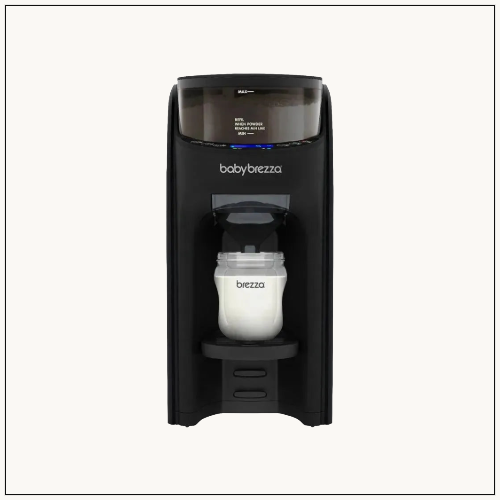
5. The Milk Machine
Baby Brezza Formula Pro Advanced
WHAT IT ACTUALLY DOES
→ Dispenses formula at the correct temperature and the correct proportion in a single button press — no kettle, no cooling, no measuring
→ Works with most major formula brands
→ Adjustable bottle sizes so it scales as the baby grows
→ Keeps water consistently at temperature so it's always ready
→ Easy-clean removable parts
→ Sits on the counter like a coffee machine — compact, contained, no nursery aesthetic required
TIME SAVED
4–5 minutes per bottle manually; under 30 seconds with the Formula Pro. Across 12 months at 6–8 bottles a day, that's 35–45 hours returned — mostly between midnight and 5 a.m.
The 3 a.m. bottle has its own atmosphere. You're not awake in any useful sense. The baby is escalating. You need a bottle in the next ninety seconds. Measuring formula in low light with one eye closed while all of that is happening is manageable in daylight. At 3 a.m. on the fourth consecutive night, it feels like an obstacle course you didn't sign up for.
One button. Under thirty seconds. That's it. The overhead disappears. What's left is the feed.
At three in the morning, the gap between five steps and one button isn't convenience. It's the difference between a day that starts level and one that starts already behind.
The milk dispenser is featured in our The Modern Mother Edit.
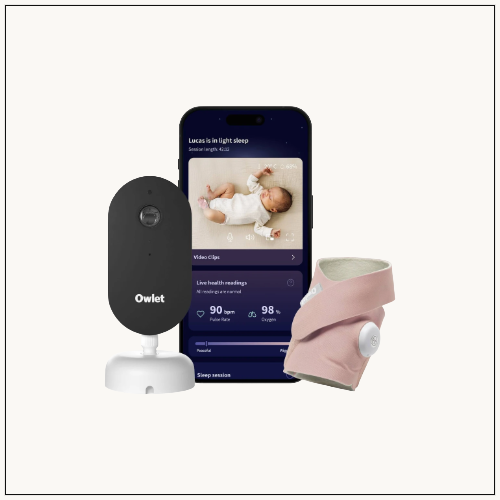
6. The tracker
Owlet Dream Sock
WHAT IT ACTUALLY DOES
→ Monitors oxygen saturation and heart rate throughout sleep — continuously, not just periodically
→ Sends an alert to your phone and to the base station if readings move outside the normal range
→ Tracks sleep stages and total sleep duration
→ Morning summary in the app — a readable account of the night
→ Designed for use from birth to around 18 months
→ The sock itself is soft and adjustable — babies sleep through wearing it
TIME SAVED
Doesn't return clock hours directly. Returns the quality of the rest you actually get. Sleep with background reassurance is more restorative than the shallow, half-alert sleep that persistent worry creates. Across months, that compounds.
There's a particular anxiety of early parenthood that isn't quite a fear — it's more like a process running in the background even while you sleep. Is the baby breathing. Is that silence forty minutes of good sleep or something else. The Owlet delegates that monitoring to the sock. Something is watching. If it needs to tell you something, it will. In the meantime, you can actually sleep.
It doesn't remove the worry of new parenthood — nothing does, or should. But it makes the worry specific rather than open-ended. A specific worry with data behind it is a different thing to carry than a formless one at 2 a.m.
It doesn't make the worry disappear. It makes it specific — and specific is manageable.
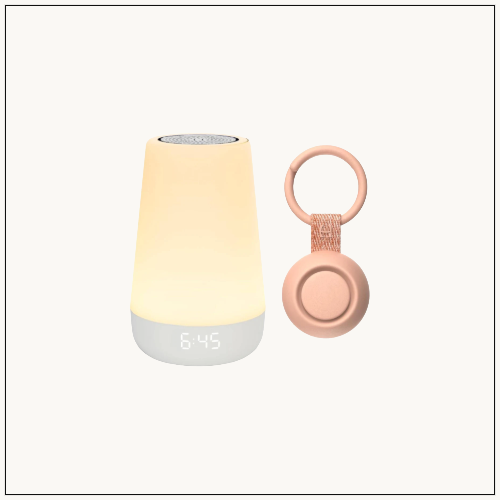
7. The Sound Machine
Hatch Rest
WHAT IT ACTUALLY DOES
→ Plays white noise, pink noise, nature sounds, lullabies — adjustable volume and type from the app
→ Nightlight with adjustable colour and brightness, also app-controlled
→ Fully programmable routines: the same sound, the same light, the same sequence every night at the same time — automatically
→ Colour-coded wake light for toddlers: stays red until it's okay to get up, turns green at the time you set
→ Works as a gradual sunrise alarm when the child is older
→ Can be controlled from anywhere via the app — adjust the volume from bed without getting up
TIME SAVED
A consistent sleep environment trims 10–20 minutes off average sleep onset in the early months. For toddlers, the wake light reliably delays the start of the day by 30–60 minutes. Recovering the 5:30 a.m. hour is not a small thing.
Newborn sleep is fragile, and the sound environment in the room matters more than most people expect going in. Silence gets interrupted by a door closing, a delivery, a dog, a car. Consistent background sound masks all of that before it registers. The Hatch holds the environment steady — same sound, same light, same sequence every night — without anyone needing to be in the room to start it.
The wake light is the feature you don't know you need until you have a toddler who is up at 5:15 and sees no reason not to be. A light that turns green when it's time to get up is a negotiation tool that works — not every time, but often enough to be worth its weight entirely.
Babies sleep better with rhythm. The Hatch doesn't create the rhythm — you do — but it makes sure the rhythm shows up every night, even when you don't have the energy to.
The Invisible Infrastructure
The baby year still requires endurance. That hasn't changed and it won't. What has changed is the number of things that can quietly hold it together alongside you.
The bassinet that catches the stir before it becomes a cry. Together they form the quiet toolkit that defines the modern baby year. The monitor that watches while you sleep. The machine that makes the bottle in thirty seconds. The sock keeping its own watch through the night. The sound machine holding the environment steady so you don't have to.
None of these change what early parenthood fundamentally is. What they change is the number of things you have to hold in your head at once — the decisions that accumulate into exhaustion when you carry them yourself, and disappear when you don't.
The best systems are the ones you stop noticing — because they're already working.
The baby year passes. What you remember are the moments with the person. The infrastructure that held those moments together is what you remember least — which is exactly what it was designed to do.
Products featured in this journal were provided by the above brands for editorial review. Each item was tested within the daily realities of the baby year and included based on its design, functionality, and relevance to the modern mother. As always, the observations and reflections shared here remain entirely our own.

THE MODERN MOTHER
This editorial is part of The Modern Mother, a Currant series exploring how motherhood is being reshaped across culture, style, design, and daily life. Through essays, journals, and curated selections, the series examines the objects, rituals, and ideas that define contemporary motherhood.
CONTINUE READING

A sharp edit of Matthieu Blazy’s first Chanel collection, highlighting the pieces that define a softer, more wearable direction for the house — and why they’re worth investing in.